

You’ve likely spent a lot of time and money setting up your workspace. Whether it’s a high-tech electronics lab, a pharmaceutical research center, or a precision engineering workshop, the equipment on your bench is often worth thousands of pounds. You’ve got the oscilloscopes, the specialized flooring, and the grounded wrist straps.
But then there’s the chair.
It’s easy to look at a standard office chair and think, "It’s just a place to sit, right?" But in a sensitive environment, that simple piece of furniture can become an invisible enemy. If you’ve ever wondered why some chairs cost a bit more and carry an "ESD" label, you’re in the right place.
In this guide, we’re going to pull back the curtain on Electrostatic Discharge (ESD) seating. We’ll look at why ordinary chairs are "static factories," how specialized seating actually works, and whether your specific environment truly needs one.
What is ESD, and Why Should You Care?
Before we dive into the chairs themselves, we need to talk about the science. Electrostatic Discharge (ESD) is the sudden flow of electricity between two electrically charged objects caused by contact, an electrical short, or dielectric breakdown.
In simpler terms: it’s that "zap" you feel when you touch a metal doorknob after walking across a carpet.
While that tiny spark might just be a minor annoyance to you, it is a death sentence for sensitive electronic components. Here is the scary part: humans usually don’t feel a static discharge until it reaches about 2,000 Volts. However, many modern microchips and circuit boards can be permanently damaged by as little as 10 to 100 Volts.
The "Silent Killer" of Electronics
In many cases, ESD doesn’t "fry" a component immediately. Instead, it causes "latent defects." The part might pass quality control and work fine for a month, only to fail once it’s in the hands of your customer. This leads to:
- Expensive product recalls.
- Frustrating troubleshooting sessions.
- A damaged brand reputation.
If you are working with PCBs, semiconductors, or sensitive laboratory sensors, ESD isn't just a buzzword, it's a critical safety protocol.
Why "Regular" Chairs are Static Factories
You might be thinking, "Can’t I just use a standard lab chair? It’s plastic and metal; surely that’s fine?"
Unfortunately, it’s not that simple. Every time you shift in your seat, your clothing rubs against the upholstery of the chair. This friction creates a phenomenon called tribocharging.
On a standard office or lab chair, the fabric and foam are usually insulators. This means the static charge has nowhere to go. It builds up on the surface of the chair and, more importantly, on you. When you eventually lean forward to touch a piece of equipment, that built-up charge finds the easiest path to ground, which is often straight through your expensive hardware.
Common Misconceptions
- "My floor is anti-static, so I'm fine." Even with ESD flooring, if your chair has standard plastic castors, it acts as an island. You are insulated from the ground, allowing charge to build up.
- "I wear a wrist strap." A wrist strap is great for when you are sitting still at the bench. But what happens when you stand up or reach for a tool across the room? An ESD chair provides a continuous, secondary path to ground that works even when you aren't "plugged in."
How ESD Chairs Actually Work (The Science of Grounding)
An ESD-safe chair isn't just a regular chair with a fancy name. It is a piece of precision engineering designed to provide a controlled, low-resistance path from the user's body to the ground.
At Chilli Seating, our ESD seating range is built using five key components to ensure you stay grounded:
1. Conductive Upholstery
Standard fabrics are static magnets. ESD chairs use specialized fabrics or vinyls that have conductive fibres woven into them. This allows the charge to move through the material rather than sitting on top of it.
2. Conductive Foam and Structure
Beneath the fabric, the foam itself is often treated to be dissipative. Furthermore, all the internal components, the seat plate, the backrest bar, and the gas lift, are interconnected to create an unbroken electrical circuit.
3. The Gas Lift and Base
In a standard chair, the gas lift is often lubricated with non-conductive grease, which can break the circuit. ESD chairs use specialized lubricants and conductive cylinders to ensure the charge travels down to the five-star base.
4. Conductive Castors or Glides
The wheels (castors) are the final "handshake" with the ground. ESD chairs use carbon-impregnated rubber or conductive plastic castors. This ensures that the electricity flows safely into your ESD-safe flooring.
5. The Resistance Range
A common myth is that an ESD chair should have zero resistance. In reality, they are designed with a specific resistance, usually between 10^6 and 10^9 ohms. This is high enough to prevent a sudden, dangerous "spark" but low enough to let the charge leak away safely and continuously.
Spotlighting the Chilli Seating Range
We know that every lab is different. A cleanroom in a pharmaceutical plant has different needs than a heavy-duty electronics assembly line. That’s why we offer specialized options built around the way you actually work.
Medium Back Vinyl ESD Draughtsman Chair
If you need an easy-clean seating option for high benches, the Medium Back Vinyl ESD Draughtsman Chair is a practical choice. The vinyl finish helps you keep the chair clean in busy technical spaces, while the draughtsman-height design and footring support better posture at raised workstations.
- Best for: Electronics labs, testing benches, and technical areas where regular wipe-downs matter.
- Common problem it solves: It helps reduce static risk without forcing you to compromise on cleanability or high-bench comfort.
Medium Back Fabric ESD Draughtsman Chair
For teams spending long hours at elevated work surfaces, the Medium Back Fabric ESD Draughtsman Chair offers a softer seating feel while still supporting ESD control. It is a strong fit when comfort is just as important as compliance, especially in labs where staff remain seated for extended periods.
- Best for: Universities, electronics assembly areas, and research environments with high desks.
- Common problem it solves: It tackles the discomfort that often comes with long shifts at high benches, while maintaining the static-dissipative performance your workspace needs.
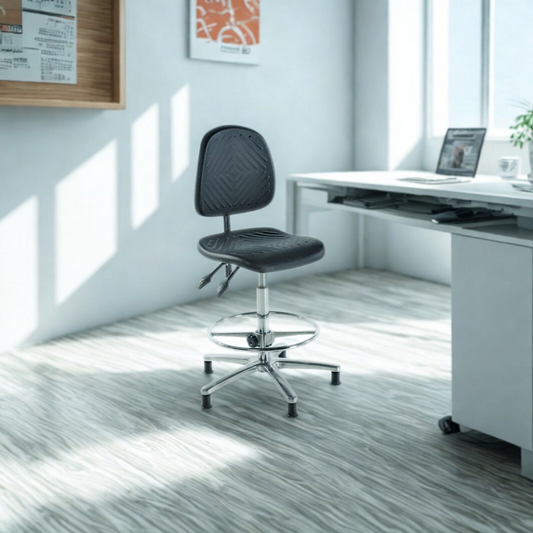
ESD Polyurethane Draughtsman Chair
In environments where chemicals, oils, dust, or heavier-duty use are part of daily life, the ESD Polyurethane Draughtsman Chair is built for the job. Polyurethane is durable, wipe-clean, and well suited to practical workspaces that need seating to be both robust and easy to maintain.
- Best for: Factories, cleanrooms, production areas, and more demanding lab settings.
- Common problem it solves: It gives you a tougher, lower-maintenance seating option that stands up well in harsher environments without losing the benefits of ESD protection.
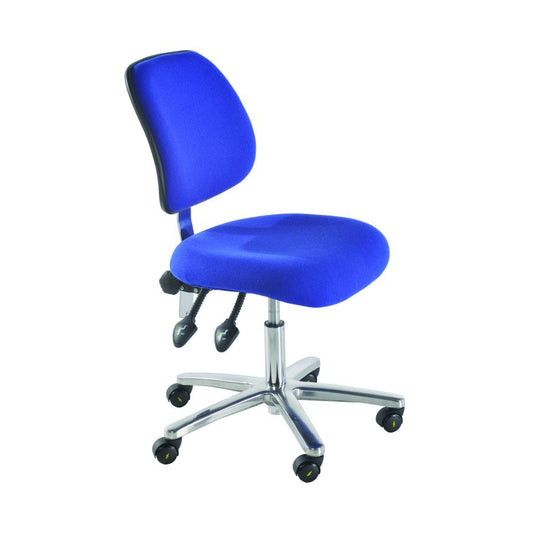
Medium Back Fabric ESD Chair
Not every ESD workstation is a high bench. The Medium Back Fabric ESD Chair is ideal for standard-height desks and seated lab tasks, giving you dependable everyday comfort with the grounding properties needed for sensitive environments.
- Best for: Standard lab benches, inspection desks, and electronics workstations.
- Common problem it solves: It provides a more comfortable alternative to basic task seating for staff who need ESD protection during full-day desk-based work.

Don't Forget the "Ergonomics" in ESD
It’s easy to get so caught up in the electrical specs that you forget someone has to sit in this chair for eight hours a day! A chair that protects your electronics but hurts your back is a bad investment.
When choosing your lab seating, look for these "human-centric" features:
- Adjustable Height: Especially important for draughtsman-style chairs used at high benches. You want your elbows to be at a 90-degree angle to the work surface.
- Back Tilt and Lumbar Support: Working in a lab often involves leaning forward (think microscopes or soldering). A chair that supports the lower back prevents the "lab slouch" that leads to long-term injury.
- The Footring: On draughtsman chairs, a sturdy, height-adjustable footring is essential. It prevents your legs from dangling, which can restrict blood flow and lead to leg fatigue.
The Verdict: Do You Really Need One?
Before you make a decision, ask yourself these three questions:
- Are you handling components that cost more than the chair? If a single "zap" can destroy a £200 circuit board, an ESD chair pays for itself the first time it prevents a failure.
- Is your environment controlled? If you have already invested in ESD flooring and matting, a standard chair is the "weak link" in your security chain.
- Does your industry have standards? Many ISO and electronics manufacturing standards (like ANSI/ESD S20.20) actually mandate the use of grounded seating.
In short: If you are working with electronics, medical devices, or sensitive sensors, the answer is a resounding yes.
But don't worry: you don't have to sacrifice comfort for safety. Whether you choose the easy-clean Medium Back Vinyl ESD Draughtsman Chair, the more cushioned Medium Back Fabric ESD Draughtsman Chair, the hard-wearing ESD Polyurethane Draughtsman Chair, or the versatile Medium Back Fabric ESD Chair, you can create a workspace that protects sensitive equipment while supporting comfort and productivity.
Ready to Ground Your Workspace?
Selecting the right seating for a technical environment can feel overwhelming, but it doesn't have to be. At Chilli Seating, we’ve helped everyone from hobbyist engineers to large-scale manufacturing plants find the perfect balance of ergonomics and ESD safety.
Check out our full range of ESD and Lab Chairs here, or get in touch with our team if you need a custom quote for your workshop.
Keep your tech safe, and your back supported. Your equipment (and your spine) will thank you!